Native-Art-in-Canada has affiliate relationships with some businesses and may receive a commission if readers choose to make a purchase.
Triple K Cooperative
The First Native Owned Silk Screen Print Shop
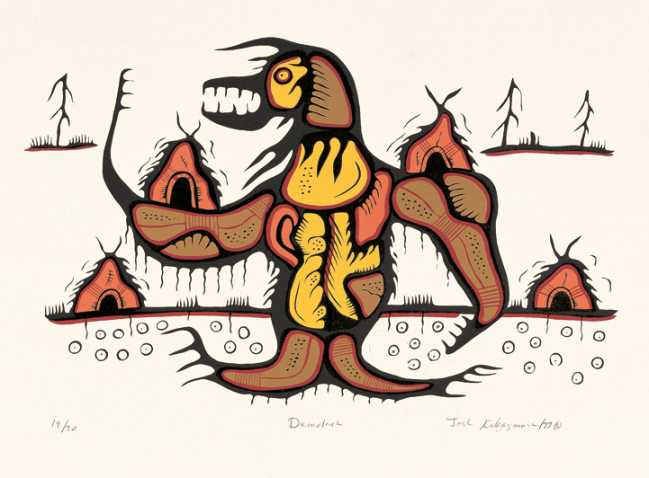 "Demolish" by Josh Kakegamic screen printed by Tiple K Cooperative
The Triple K Cooperative was created in 1973 in Red Lake, Ontario by Josh and Henry Kakegamic with much help from their father David and their brother Goyce. It was the first native silk-screening production company in Canada.
Josh Kakegamic and other Red Lake artists had been inspired by Norval Morrisseau and they were among the first artists who painted in a manner that would eventually be known as the Woodland School.
The bold shapes and clear lines of the woodland style were especially well suited to the craft of screen printing. But, the costs involved in printing were inhibiting. Distance was a factor because an artist had to be involved in the decision making while the job is being set up and sign the final approval before the run started. Driving back and forth from Red Lake to a screen printer in the south was expensive.
To avoid upfront costs, any artist can sell the reproduction rights of an original work to an art dealer or screen printer who bears the production and distribution costs in return for paying the artist a royalty for each print sold.
Unfortunately, some screen printers took advantage of the new woodland artists, paying them very little while printing and distributing their work without proper consultation or consent.
Josh Kakegamic enrolled his family in setting up Triple K Cooperative in Red Lake because he wanted to maintain artistic control over his work.
But, Red Lake is a gold mining town 100 air miles north of Kenora and 180 air miles east of Winnipeg. Screen printing expertise was non-existant.
It was a daunting task for the Kakegamics to learn and master the skills needed to gain serious recognition by the art industry. Distribution, commission structures, art gallery/artist responsibilities and copyright were all unfamiliar topics.
In the beginning the print shop produced a number of unlimited reproductions on cloth and paper, chiefly by brothers Joshim and Goyce, but gradually the Co-op reassessed its approach to printing and its role in the artist/printer relationship.
Triple K specialized in
original limited edition prints.
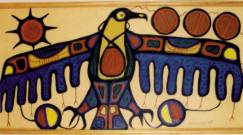 A Triple K Cooperative screen print of a Thunderbird by Norval Morrisseau.
Because of the growing reputations of some of the artists involved, and particularly because they'd begun printing works by Norval Morrisseau, Triple K Cooperative began printing only original limited edition prints on archival paper. Each print was signed and numbered by the artist.
In the area of silk screening, the term original prints needs explanation. The silk screen prints at Triple K were made from drawings specifically designated for the silk screen process by the artist who stipulated all the colours in the design and was involved during critical stages of the process.
A single proof was printed and submitted to the artist for approval. If accepted, the artist would sign and date the proof. If not, the initial process was repeated incorporating the changes desired by the artist until finally the bon a tirer was approved. After the final proof was signed by the artist the entire edition was printed. Each image was signed and numbered by the artist. No further prints were ever made of that image, hence the name 'limited edition'.
Triple K Cooperative and the "Business" of Art
By 1975 the lack of contractual safeguards meant that work by many native artists was being reproduced without the artist's consent and without specific royalty arrangements. The Triple K Cooperative retained the services of a copyright lawyer and were able to resolve many disputes, most to the benefit of the artist.
Distribution of the prints was a trial and error process for the first eighteen months that the Co-op was in business. Eventually they made an agreement with Roy Maxwell, a man of integrity whose experience and extensive knowledge of the Canadian art market allowed the Co-op's prints to be distributed to approximately fifty galleries across the country.
The distribution further enhanced the reputations of Co-op members and gave younger artists opportunities normally not available in isolated communities. Recognition often led to enquiries about other works by the artists and often direct contacts and gallery shows.
The Royal Ontario Museum held an exhibition in 1977 entitled Contemporary Native Art of Canada - Silk Screens from the Triple K Co-operative, Red Lake, Ontario.
The Triple K Cooperative closed its doors in 1980. But works by artists that had been supported by the coop can still be found at auction or through galleries that specialize in First Nations art, especially Woodland Art.

Influence of the Indian Group of Seven
Cultural Renaissance and the Woodland School
 |
 |
 |